Solar Agricultural Drying Technology for Sustainable Value Addition
Wiki Article
Introduction
The use of solar energy in agriculture is often associated with electricity, irrigation or other power applications, but solar thermal technology can also support food and agricultural processing. Drying is one of the most direct examples because the process requires heat and airflow rather than electricity alone.
Rudra Solar Energy develops solar thermal systems and offers solar dryers for agricultural, food and other compatible applications. The company's current range includes general cabinet dryers as well as product-focused systems for fruits, vegetables, spices, herbs, grains, pulses, seeds, oilseeds and flowers.
Solar Drying and Sustainable Processing
Solar drying uses sunlight as the primary thermal resource. Where a suitable solar resource is available, this can reduce dependence on conventional thermal energy.Rudra Solar Energy states that its solar dryers can reduce dependence on LPG, diesel, electricity or other fuel-based drying methods where those sources are currently used.
Understanding the Baseline
The sustainability and cost implications depend on what process is being replaced.A business replacing LPG-based drying may see a different energy impact from a farmer moving from open-sun drying to an enclosed solar dryer.
Solar Drying for Agricultural Communities
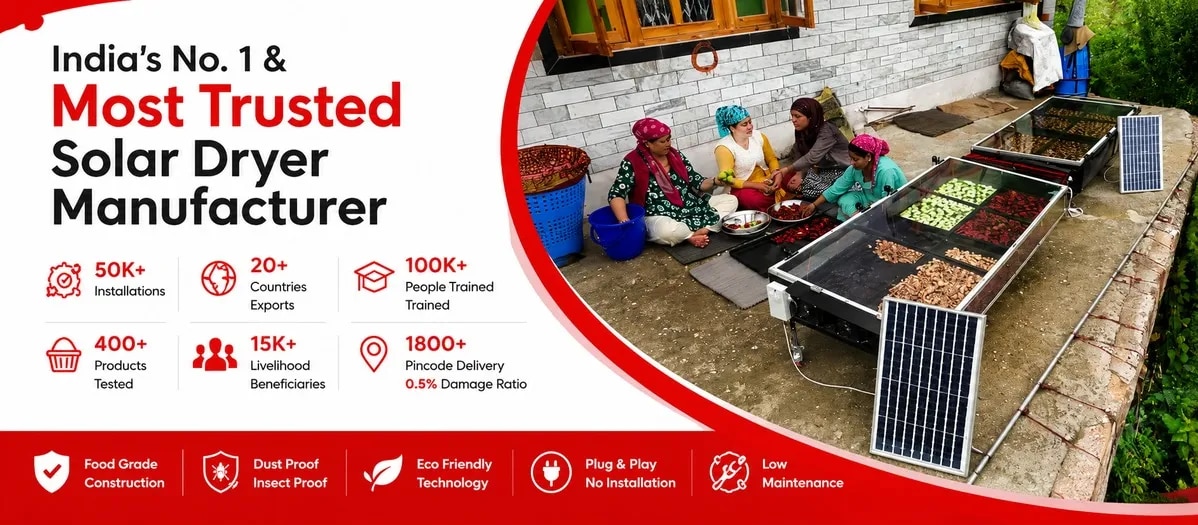
Solar dryers can be relevant to farmers, SHGs, FPOs and rural entrepreneurs. Rudra Solar Energy states that it supplies systems across rural, remote, hill and off-grid areas of India. :contentReference[oaicite:82]index=82FPO Applications
FPOs can use processing equipment to create shared value-addition infrastructure. Instead of each farmer independently processing small quantities, a common facility may support collective processing.The actual model depends on the organisation, crop availability, management and market.
Solar Drying and Food Processing
Food-processing businesses can also evaluate solar drying for suitable raw materials.Rudra's solar food processing dryer is designed for prepared fruits, vegetables, herbs, spices, grains, pulses and other compatible ingredients.
Processing Steps
A typical process may include:- Raw material inspection
- Cleaning
- Preparation
- Cutting or slicing
- Tray loading
- Solar drying
- Cooling
- Packaging
- Storage
The exact sequence varies according to the product.
Enclosed Drying Environment
A solar dryer can provide a more controlled physical environment than open-sun drying. Rudra describes its cabinet dryer as reducing direct exposure to dust, insects, birds and sudden rain. :contentReference[oaicite:84]index=84This can be particularly relevant to Solar Drying Technology processors that need organised handling practices.
Hygiene Is a Complete Process
The machine is only one part of hygiene. Raw materials, operators, trays, equipment surfaces, packaging and storage all need appropriate management.Capacity and Resource Planning
Rudra's cabinet solar dryers are available from 5 kg per batch to 500 kg per batch. :contentReference[oaicite:85]index=85A business should select capacity based on realistic raw-material availability.
Important planning factors include:
- Fresh input per batch
- Number of batches
- Seasonality
- Processing space
- Solar exposure
- Labour availability
- Packaging capacity
- Future expansion
Technology and Local Conditions
Solar dryer performance is influenced by local climate and operating conditions. Solar radiation, humidity, temperature and airflow can affect drying.Rudra's location Know More guidance indicates that the selected model and capacity should be considered in relation to the user's location and application.
Remote and Off Grid Applications
Solar dryers may be particularly relevant where access to conventional fuels or electricity is limited, although the actual suitability depends on solar resource, product requirements and site conditions.Long Term Operation
Sustainable equipment use also requires maintenance. Operators should Solar Dehydrator clean food-contact surfaces, inspect the system and follow manufacturer guidance.Keeping process records can help operators understand seasonal differences and identify the conditions that work best for each product.
Conclusion
Solar drying connects renewable solar thermal energy with agricultural and food processing. It can reduce dependence on conventional drying energy in appropriate applications and provide an enclosed alternative to open-sun drying.Rudra Solar Energy offers solar dryers for farmers, FPOs, SHGs and food-processing businesses, with multiple capacity and application options.
The technology should be selected according to product characteristics, quantity, climate, processing workflow and business requirements. Sustainability benefits should also be evaluated against the actual existing process. With proper planning and operation, solar drying can support practical agricultural processing while making productive use of available solar energy.
 Report this wiki page